US Iran Strikes 2026: Drones Hit Kuwait Airport in New Attack
The conflict between the US and Iran has escalated yet again. Overnight, both sides traded fresh strikes. Iranian drones also hit Kuwait’s main airport, and the new US Iran strikes have rattled the whole Gulf. Here is a clear, neutral look at what each side says happened.
How the war began
This crisis did not appear overnight. The wider war broke out earlier in 2026, when the US and Israel launched air attacks on Iran. In response, Iran moved to choke off shipping through the Strait of Hormuz. The US then started its own air campaign and, later, a naval blockade to reopen the route. Since then, Iran has repeatedly fired at Bahrain and Kuwait, where US troops are based. Wednesday’s clash is the latest turn in that long cycle.
New US Iran strikes hit the Gulf
US Central Command (Centcom) said it struck an Iranian military ground control station on Qeshm Island, in the Strait of Hormuz. It called the action “self-defence” and a response to attempted Iranian attacks across the Middle East. In addition, US forces shot down three Iranian drones aimed at civilian ships.
Iran also fired several ballistic missiles at Gulf states, according to Centcom. Two missiles aimed at Kuwait fell short or broke apart. Meanwhile, US and Bahraini air defences intercepted three more missiles fired at Bahrain.
Drones strike Kuwait airport
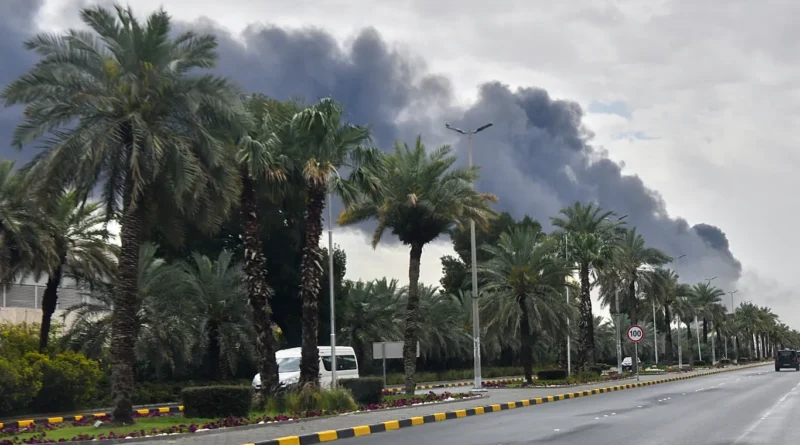
The worst damage landed in Kuwait. The Kuwaiti army said Iranian drones hit Kuwait International Airport, causing “significant” building damage and injuring several people. As a result, Kuwait suspended air traffic on Wednesday morning.
Defence ministry spokesman Brigadier General Saud Abdulaziz Al-Otaibi called the attack “criminal Iranian aggression”. He added that the wounded had received care. Reportedly, this was the third Iranian attack on Kuwait in about a week. Notably, the country hosts US military bases.
Iran tells a different story
Iran offered a very different account. Its Revolutionary Guard (IRGC) said the clash began after a US projectile hit an Iranian oil tanker near the strait. In response, it said it targeted an “American-Zionist” vessel and then struck US-linked bases in the region.
The IRGC claimed it had destroyed all its targets. It also warned that disrupting the strait would carry a “heavy price” for the US military. However, Centcom rejected Iran’s claim of hitting a US airbase and the Fifth Fleet headquarters in Bahrain. Every attack on American forces failed, it insisted.
The blockade on the Strait of Hormuz
This flare-up follows a US naval blockade of the strait, in place since 13 April. Earlier, Centcom said it disabled an oil tanker heading toward Iran, the Botswana-flagged M/T Lexie. A US aircraft then fired a Hellfire missile into its engine room after the crew ignored repeated warnings.
Overall, Centcom said it has disabled six commercial ships and redirected 122 since the blockade began. The strait matters because much of the world’s oil and gas passes through it. For that reason, any trouble there shakes global energy markets.
Ceasefire talks stall
The violence comes as US-Iran ceasefire talks have stalled. Over the weekend, negotiations to end the months-long war failed to move forward. Still, President Donald Trump told critics to “sit back and relax”, claiming Iran “really wants to make a deal”.
US media reported that Trump wanted changes to the deal, covering the strait and the removal of highly enriched uranium. However, Iran’s foreign ministry spokesman Esmail Baghaei denied those terms were ever on the table. He accused Washington of constantly shifting its demands.
Meanwhile, Secretary of State Marco Rubio testified before Congress for the first time since the war began. He said any sanctions relief would be “condition-based” and tied to Iran’s nuclear programme. In one tense exchange, he insisted “the war is over” — even as the strikes went on.
Why it matters
For people across the Gulf, the impact is immediate. A civilian airport sits damaged, flights remain grounded, and the threat of drones still lingers overhead. For the wider world, the danger centres on the Strait of Hormuz and the oil that flows through it.
Each new round of strikes raises the risk of miscalculation. It also makes a lasting ceasefire harder to reach. For now, with both sides telling different stories, the crisis stays tense and fast-moving.
This war is one of several reshaping the region in 2026. For another key story, read our update on the latest on the Gaza ceasefire.