WHO Report 2026: Global Health Targets Are Failing — And Air Pollution Is Killing Millions
The World Health Organization released its World Health Statistics 2026 report, and the findings are a sobering counterweight to any optimism about global development progress. The headline conclusion is stark: no country in the world is currently on track to achieve any of the health-related Sustainable Development Goals by the 2030 deadline. Not a single one. And running through almost every category of failure — from life expectancy to child mortality to chronic disease — is the same invisible threat: air pollution.
This is not a story about faraway problems affecting only developing nations. Air quality, climate-related disease burden, and healthcare system collapse are issues that touch every country and every income level. The 2026 WHO report makes that clear in ways that previous editions did not, and understanding what it found is essential for anyone who cares about health, policy, or the future of global public infrastructure.
The Numbers Behind the Crisis
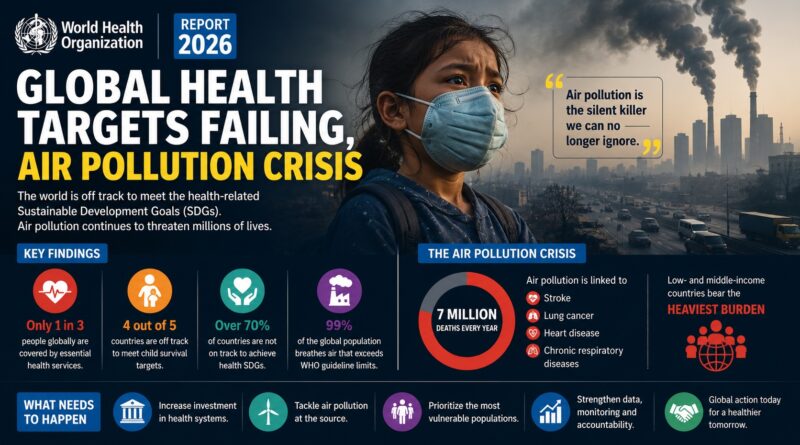
The WHO report documents that air pollution was responsible for an estimated 6.6 million deaths in 2021 — the most recent year for which fully verified global data exists. That number makes air pollution the single largest environmental health risk on the planet, accounting for more premature deaths than malaria and HIV/AIDS combined. The majority of these deaths occur in low- and middle-income countries, particularly in South and Southeast Asia and sub-Saharan Africa, where both outdoor industrial pollution and indoor pollution from cooking fires remain at crisis levels.

Air pollution is the world’s largest environmental health risk, contributing to 6.6 million deaths per year according to the WHO’s 2026 statistics report.
What makes the 2026 data particularly troubling is that it does not simply reflect a problem inherited from decades of industrialization. Climate change is making air quality worse in regions that had been improving. Wildfires — driven by hotter, drier conditions — are producing smoke events that push air quality indexes into hazardous territory in regions including western North America, southern Europe, and Australia that were not historically major pollution zones. The health burden from wildfire smoke is now large enough to register in national mortality statistics.
Why No Country Is on Track for the 2030 Health SDGs
The Sustainable Development Goals set by the United Nations include several direct health targets: ending preventable deaths of newborns and children under five, achieving universal health coverage, reducing premature mortality from non-communicable diseases like heart disease, diabetes, and cancer, and ensuring universal access to sexual and reproductive health services. The WHO’s 2026 assessment finds that progress on every one of these indicators has either stalled or reversed since 2019.
The COVID-19 pandemic is one part of the story — it set back vaccination programs, overwhelmed health systems, and diverted resources from chronic disease management. But the deeper problem is structural. Many countries, particularly in sub-Saharan Africa and South Asia, entered the pandemic decade with healthcare infrastructure already inadequate to the scale of need. The disruption of COVID compounded pre-existing deficits in ways that will take years to reverse.
Non-Communicable Diseases Are the Growing Burden
Heart disease, stroke, diabetes, and cancer — collectively non-communicable diseases, or NCDs — now account for roughly 74% of all deaths globally. This shift from infectious to chronic disease as the dominant health burden represents one of the most significant epidemiological transitions in human history. And it creates a challenge that healthcare systems designed around acute care and infectious disease are poorly equipped to handle.
Air pollution is directly linked to several of the leading NCDs. Long-term exposure to fine particulate matter — the PM2.5 particles that penetrate deep into lung tissue — increases the risk of cardiovascular disease, stroke, lung cancer, and chronic obstructive pulmonary disease. Researchers now estimate that air pollution contributes to cardiovascular deaths at rates comparable to tobacco smoking. The mechanisms are different, but the mortality burden is similar in scale.
Which Regions Are Most Affected
The WHO data makes clear that the health burden is not distributed equally. South Asia — particularly India, Pakistan, and Bangladesh — has some of the worst air quality readings in the world, driven by a combination of vehicle emissions, industrial output, agricultural burning, and cooking fires that use solid fuels. Cities like Delhi, Lahore, and Dhaka regularly record PM2.5 levels ten to twenty times higher than the WHO’s recommended limits.
Sub-Saharan Africa faces a different profile of risk. Indoor air pollution from cooking fires using wood, charcoal, and crop waste is a major killer, particularly affecting women and children who spend the most time near cooking fires. The transition to cleaner cooking fuels has been slower than development targets anticipated, and funding for clean cooking programs has been inadequate relative to the scale of the problem.
High-income countries are not insulated from the crisis, though the specific threats differ. In Europe and North America, the primary concerns are wildfire smoke, traffic-related particulate pollution in urban areas, and the growing health burden of climate-amplified heat events, which interact with air pollution to increase cardiovascular and respiratory mortality.
What the Report Recommends — and What Would Actually Help
The WHO’s recommendations are clear even if their implementation is politically difficult. Accelerating the transition away from fossil fuels in power generation and transportation is the most impactful single action available. Expanding access to clean cooking technologies in low-income countries requires dedicated financing — current funding falls billions of dollars short of what is needed. And healthcare system strengthening, particularly in primary care infrastructure, is essential for managing the chronic disease burden that air pollution and other environmental exposures are driving.
On the policy side, the full WHO 2026 report outlines country-specific recommendations and benchmarks. The UN Environment Programme’s air quality tracking tools allow anyone to explore current air quality data for their region alongside historical trend lines.
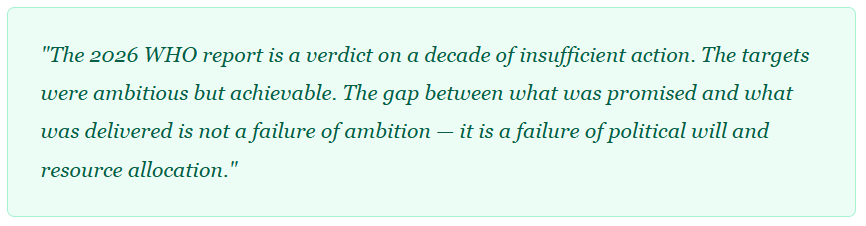
The 2030 deadline for the SDGs is four years away. The WHO report’s conclusion — that no country is on track — is not a reason for fatalism. It is a reason for urgency. The technologies and policy tools needed to make meaningful progress exist. What has been missing is consistent application of political will and financial resources at the scale the problem demands. Whether the next four years look different from the last decade will depend on decisions being made right now in governments and international institutions around the world.