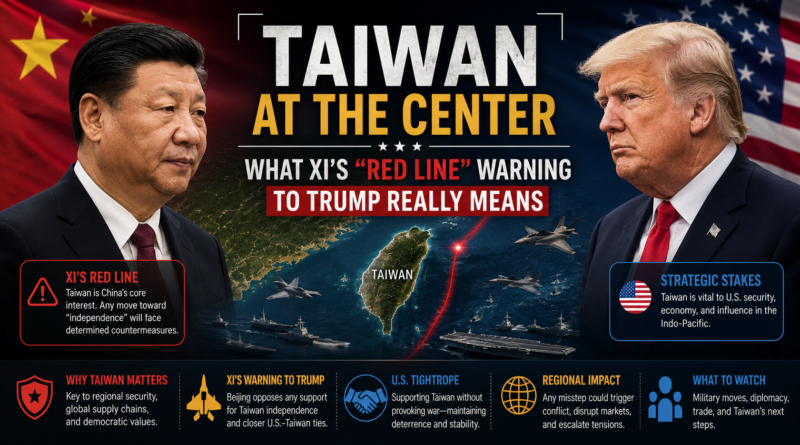
Taiwan at the Center: What Xi’s “Red Line” Warning to Trump Really Means
At the Trump-Xi summit, China’s president said something that got buried under the trade headlines but may matter far more in the long run. Xi Jinping told Trump directly that Taiwan is “the most important and sensitive issue” in US-China relations, and that mishandling it could lead to “clashes and conflicts” between the two superpowers. This was not diplomatic boilerplate. It was a precise, deliberate warning — and understanding what it means requires looking at what is actually happening across the Taiwan Strait right now.
Taiwan has been a flashpoint in US-China relations for decades, but the stakes and the urgency have risen sharply. Chinese military activity around Taiwan has escalated significantly. US arms sales to Taipei have accelerated. And Taiwan’s own 2024 elections produced a government in Taipei that Beijing views as dangerously independence-leaning. The triangle of pressures is tighter than it has been at any point since the Third Taiwan Strait Crisis in 1996.
Why Xi Is Drawing the Line Now
China’s position on Taiwan has not changed — Beijing considers the island a province of China and has never renounced the use of force to achieve unification. What has changed is the combination of capability and impatience on the Chinese side, and the depth of US commitment to Taiwan’s security on the American side.
China’s People’s Liberation Army has undergone a transformation over the past decade specifically oriented toward a Taiwan scenario. Its navy is now larger than the US Navy by vessel count, though the US retains significant quality and experience advantages. Its air force has modernized dramatically. And its missile arsenal — particularly anti-ship ballistic missiles designed to keep US carrier groups at a distance — represents a genuine and growing challenge to American military planners.
Taiwan’s strait has become the most strategically contested waterway in the world. Military tensions between the US and China continue to escalate in 2026.

The Economic Stakes Nobody Talks About Enough
Taiwan’s geopolitical importance goes far beyond its 23 million people or its claimed sovereignty. Taiwan Semiconductor Manufacturing Company — TSMC — produces over 90% of the world’s most advanced semiconductor chips, the components that power everything from smartphones and cars to weapons systems and AI data centers. No country on Earth can replace this capacity in the near term. An interruption of Taiwanese chip production, whether through military conflict or prolonged blockade, would send shockwaves through the global economy that would dwarf anything caused by the COVID-19 supply chain disruptions.
This is why major economies beyond the US and China — Japan, South Korea, the EU, Australia — all have direct and acute interests in Taiwan’s stability. It is also why the US has been investing heavily, through the CHIPS Act and related legislation, to build domestic semiconductor capacity as a hedge. But that capacity will take years to reach scale, and in the meantime Taiwan’s chip industry remains an extraordinary concentration of strategic risk in a single geographically small location.
What “Strategic Ambiguity” Means and Why It Is Under Pressure
For decades, US policy on Taiwan has rested on a doctrine called strategic ambiguity — Washington acknowledges that China claims Taiwan but does not recognize that claim, sells Taiwan defensive weapons, and deliberately avoids saying whether it would send US troops to defend Taiwan if China attacked. The ambiguity was designed to deter both a Chinese attack and a Taiwanese declaration of independence.
That policy is fraying. President Biden stated multiple times — and was walked back by the State Department each time — that the US would defend Taiwan militarily. Senior military officials have given assessments of when a Chinese attack might occur. Taiwan’s government has made clear it would resist any attempt at forced unification. And China has made equally clear that it reads increased US-Taiwan military cooperation as a provocation that reduces rather than increases the chances of peaceful resolution.
What Xi’s Warning to Trump Actually Signals
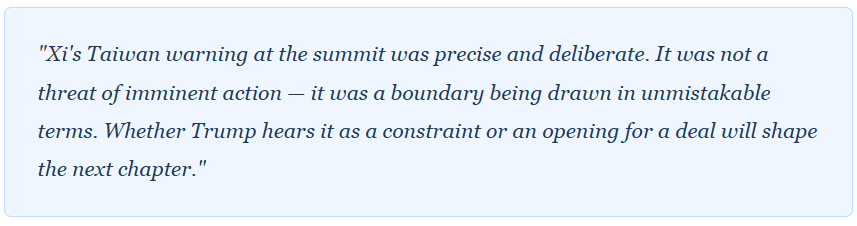
Xi’s summit message to Trump was calibrated. He was not threatening imminent military action — he was drawing a boundary and testing whether the new administration would respect it. The specific phrase “clashes and conflicts” is language that Chinese officials reserve for situations they consider genuinely dangerous rather than merely contentious. It signals that Beijing believes the current trajectory is not sustainable and that China’s tolerance for what it considers US interference in Taiwan is not infinite.
Trump’s response, as with most of his foreign policy, is transaction-oriented. He is more focused on trade concessions and economic deals than on the abstract principles of Taiwanese democracy or international law. That creates both an opening — China might offer economic sweeteners in exchange for a cooler US posture on Taiwan — and a risk. If Taiwan’s security is treated as a bargaining chip in a broader economic negotiation, the implicit deterrence that has kept the peace across the strait for 50 years could weaken in ways that are difficult to reverse.
What to Watch in the Months Ahead
Several developments will signal where this is heading. Watch whether US arms sales to Taiwan continue at their current pace or slow — any slowdown would be read by Beijing as a concession. Watch whether Taiwan’s government uses more assertive independence language publicly — Beijing will treat that as a provocation that changes the calculus. Watch Chinese military exercise patterns around the strait — an escalation in frequency or complexity of exercises near Taiwan signals that Beijing is shifting from political pressure to military signaling.
The Taiwan situation is the single most consequential geopolitical risk for global stability in 2026. Its resolution — peaceful or otherwise — will define the shape of international relations for decades. Right now, the best available outcome is continued managed tension without military escalation. Getting from here to there requires careful navigation from all three governments involved: Beijing, Washington, and Taipei. At the moment, the margin for error is uncomfortably thin.