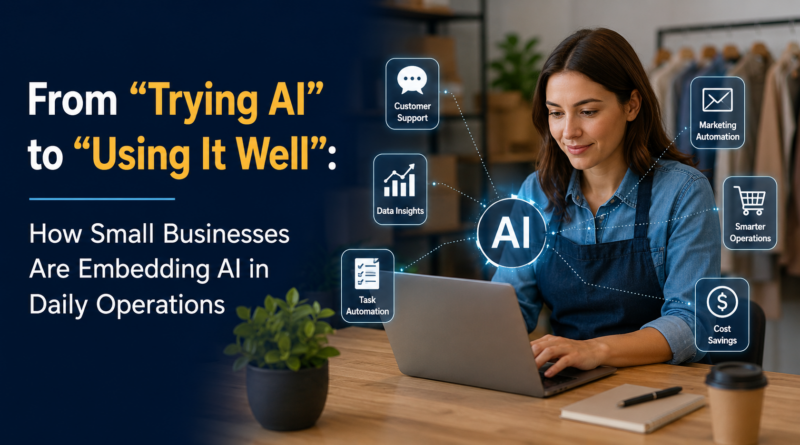
From “Trying AI” to “Using It Well”: How Small Businesses Are Embedding AI in Daily Operations
A year ago, most small business owners were “exploring AI.” They signed up for tools, watched demos, and maybe used ChatGPT to draft a few emails. In 2026, the conversation has completely shifted. The businesses that are pulling ahead are not the ones experimenting anymore — they are the ones that have woven AI into their daily workflows so deeply that removing it would break how they operate.
This shift is not about having a big tech budget or a dedicated IT team. It is about picking the right problems to solve, choosing tools that fit without friction, and being consistent. Here is what that actually looks like on the ground — and what small business owners and entrepreneurs need to know to stop dabbling and start winning with AI.
Why 2026 Is the Year AI Moves from Experiment to Infrastructure
The tools have matured dramatically. AI assistants that were unreliable or clunky in 2023 are now genuinely useful, faster, cheaper, and far easier to integrate into existing software stacks. Platforms like QuickBooks, Shopify, HubSpot, and Canva have embedded AI features directly into the tools small businesses already use. You do not need to build anything — the capability is already in software you are probably paying for.
The competitive pressure is also real. According to 2026 small business trend surveys, businesses that actively use AI report saving an average of 5 to 10 hours per week on administrative and repetitive tasks. That time compounds quickly. A business saving 8 hours a week gains over 400 hours annually — more than 10 working weeks — to reinvest in growth, customer relationships, or product development.
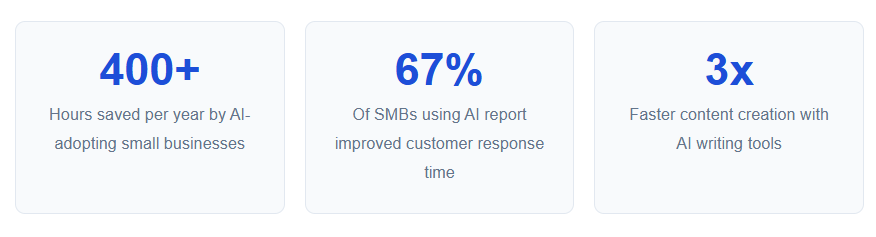

AI tools are no longer a luxury — they are becoming core infrastructure for competitive small businesses in 2026.
Where Small Businesses Are Actually Using AI Right Now
The most effective AI implementations in small businesses are not the flashy ones. They are the boring, repetitive, time-consuming tasks that used to eat hours every week. That is where the real return on investment is.
Customer Communication and Support
AI-powered chat tools and email assistants are handling first-response customer queries, appointment scheduling, FAQ responses, and follow-up emails. A boutique retail store can have an AI assistant handle 80% of incoming customer questions — stock availability, return policies, store hours — without any human involvement. The owner only steps in for complex or sensitive situations. Tools like Tidio, Intercom, and Zendesk AI all offer small business pricing tiers that make this accessible.
Marketing and Content Creation
Writing blog posts, social media captions, product descriptions, newsletters, and ad copy used to require either a dedicated hire or hours of the owner’s time. AI writing tools — Claude, Jasper, and Copy.ai among them — have reduced the time to produce a polished first draft from hours to minutes. The key shift in 2026 is that business owners have learned to treat AI output as a strong first draft, not a finished product. They edit, add their voice, and publish. That workflow is dramatically more efficient than starting from a blank page.
Financial Tracking and Payroll
AI features inside accounting platforms are now catching categorization errors, flagging unusual expenses, predicting cash flow shortfalls, and automating routine payroll calculations. Small business owners who used to spend Sunday evenings sorting receipts now review AI-categorized transactions in ten minutes. The accuracy has improved to the point where most routine bookkeeping needs only a light human review.
Hiring and HR Tasks
Writing job descriptions, screening resumes for basic requirements, scheduling interviews, and drafting offer letters are all tasks where AI tools are saving business owners significant time. Platforms like Breezy HR and Workable have AI screening built in. For a small team hiring two or three people a year, this eliminates a frustrating and time-consuming process.
The Mistakes Small Businesses Still Make with AI
Not every AI implementation is working. The most common failure pattern is what consultants are calling “tool sprawl” — a business subscribes to six different AI tools, uses none of them consistently, and ends up spending more on subscriptions than the tools save in time. The fix is simple: pick one or two workflows where the pain is highest, solve those completely, and only then expand.
“The businesses pulling ahead in 2026 are not the ones with the most AI tools. They are the ones who went deep on a few workflows, got really good at using AI there, and built habits around it before adding anything new.”
The second common mistake is trusting AI output without reviewing it. AI tools can produce convincing-sounding content that contains factual errors, tone mismatches, or information that does not reflect your actual business. Every AI output needs a human check before it reaches a customer. The goal is speed plus quality, not just speed.

How to Start If You Have Not Already
If your business is still in the “trying AI” phase, the path forward is straightforward. Identify the task that takes the most time each week and produces the least strategic value. That is your first AI project. Write down exactly what the task involves, find a tool that handles it, and commit to using it consistently for 30 days before judging the results.
The US Small Business Administration has published guidance on evaluating AI tools, including checklists for data privacy, vendor reliability, and total cost of ownership. For any tool that touches customer data or financial information, those considerations matter and should not be skipped in the rush to implement.
The window to gain a real competitive advantage from AI in small business is still open — but it is closing faster than most owners realize. The businesses that embed these tools into their operations now, build habits around them, and improve iteratively will be significantly harder to compete with 12 months from now. The ones that keep waiting for the “right moment” will find they are two years behind with no easy way to catch up.