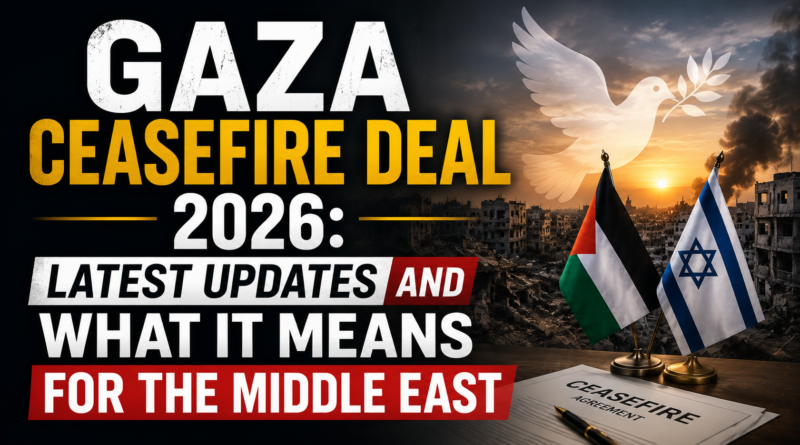
Gaza Ceasefire Deal 2026: Latest Updates and What It Means for the Middle East
More than six months after it was signed, the Gaza ceasefire 2026 remains in place but deeply fragile. The deal halted the heaviest fighting of a war that lasted roughly two years, yet it has not delivered the recovery or stability many hoped for. Here is where things stand and why the coming months are so important for the region.
How the ceasefire came about
The agreement between Israel and Hamas was reached on 10 October 2025, brokered internationally after a devastating conflict. According to figures cited in the agreement’s context, the war left more than 72,000 Palestinians dead and tens of thousands injured. The deal called for an immediate halt to major ground and air operations and a phased Israeli withdrawal, and it was meant to open the door to reconstruction and a longer-term political settlement.
What is happening on the ground now
The reality has been described by observers as “neither war nor peace.” The truce has reduced large-scale fighting, but it has been punctuated by repeated strikes and clashes. Under the deal, Israeli forces pulled back to a boundary known as the “yellow line,” which covered a little over half of Gaza. Aid groups report that the line has since shifted, with maps indicating Israeli control of a larger share of the territory. According to the Palestinian Ministry of Health, hundreds of people have been killed since the ceasefire took effect, underlining how shaky it remains.
The sticking points
Two obligations sit at the centre of the dispute. International officials say a full Israeli troop withdrawal has not taken place, while Hamas has not committed to the disarmament the agreement envisaged. A US-founded body overseeing the deal, sometimes called the Board of Peace, presented a roadmap to the UN Security Council urging both sides to meet their commitments — pressing Hamas to disarm and calling on Israel to uphold its side. Without movement on both, mediators warn the situation could harden into a long-term stalemate.
A worsening humanitarian picture
Conditions for civilians remain severe. UN agencies estimate that close to a million people still need urgent shelter, while damaged roads, checkpoint delays and restrictions slow the flow of aid. A 2026 humanitarian appeal seeking billions of dollars has been only a fraction funded, leaving relief efforts badly stretched. Officials repeatedly stress that the population cannot withstand a return to full-scale war.
What it means for the Middle East
The risk many analysts highlight is a “permanent” division of Gaza if the transition stalls, with the temporary lines on a map hardening into a lasting reality. Regional attention has also been split, with a separate conflict involving Iran pulling focus and resources. For the wider Middle East, the central question is whether this truce becomes the first step toward a durable settlement or simply a pause between escalations. The answer depends largely on whether the disarmament and withdrawal terms are enforced in the months ahead.
The human cost so far
Behind the diplomatic language sits a severe humanitarian emergency. UN agencies estimate that close to a million people still need urgent shelter, while much of the population remains displaced. Damaged roads, checkpoint delays and restrictions on supplies continue to slow aid, and a 2026 relief appeal seeking billions of dollars has been only a small fraction funded. Aid officials repeatedly warn that the population simply cannot absorb a return to full-scale war, which raises the stakes for keeping even a fragile truce alive.
Who is involved in the diplomacy
The ceasefire did not emerge in isolation. International mediators, historically including the United States, Egypt and Qatar, have shaped the talks, and a US-founded oversight body is now tasked with pushing both sides toward their commitments. The UN Security Council has held repeated debates on transitional governance and reconstruction, signalling that the world’s focus is shifting from stopping the fighting to deciding what comes next. That question — who governs and rebuilds Gaza — remains unresolved and deeply contested.
The possible paths forward
Broadly, three scenarios are on the table. The hopeful one is a durable settlement, where withdrawal and disarmament terms are met and reconstruction begins in earnest. The most-warned-about is a frozen status quo, where temporary lines harden into a near-permanent division of the territory. The worst case is a slide back into open war. Which path unfolds depends largely on enforcement and political will, and for now the region sits uneasily between them, watching to see which way the truce tips.
What to watch in the months ahead
A handful of signals will reveal which way the truce tips. The first is whether the promised Israeli withdrawal actually advances or the control lines keep shifting. The second is any movement on Hamas disarmament, the issue mediators say is blocking the next phase. Aid is the third: whether funding for the humanitarian appeal improves and supplies flow more freely. Finally, watch the politics of reconstruction and governance, and any spillover from the wider regional conflict. Progress on these points would suggest a path toward stability; stalling on all of them would point toward the “permanent” division officials keep warning about.
Why this matters beyond the region
A conflict this size never stays local. Energy markets, refugee flows, regional alliances and global diplomacy all respond to what happens in Gaza, which is why governments far from the Middle East follow each development closely. Whether the ceasefire holds or collapses will shape security and politics across the region for years, making it one of the defining international stories of 2026 to keep watching.
Geopolitics rarely moves in isolation, and 2026 is a crowded year for global affairs. For another defining story shaping the year, see our guide to the US midterm elections 2026, where domestic politics will influence foreign policy too.