Trump vs. Iran: What a Possible Military Strike Could Mean for the Middle East
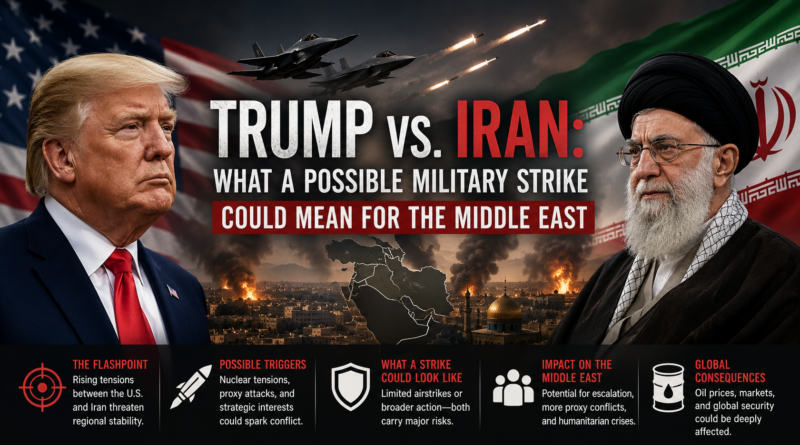
The language coming out of Washington on Iran in 2026 is not diplomatic. President Trump has told Tehran in explicit terms to move toward a nuclear agreement or face consequences that would leave “nothing left.” The US has repositioned military assets in the region, and intelligence briefings referenced in multiple outlets suggest strike planning has been discussed at senior levels. At the same time, Trump has pulled back from imminent action at least once following outreach from regional leaders. The situation is volatile, and the stakes for the Middle East — and for the global economy — are enormous.
Understanding what a US military strike on Iran would actually mean requires looking past the headlines at the real strategic, economic, and humanitarian dimensions of this confrontation.
Why Iran Is Back at the Center of US Foreign Policy
Iran’s nuclear program has advanced significantly in recent years. Western intelligence agencies assess that Tehran has enriched uranium to levels close to weapons-grade, and the timeline to a functional nuclear device — if that decision were made — has compressed to a matter of weeks rather than years. This reality is driving urgency in Washington in a way that previous administrations, which also sought to contain Iran’s nuclear ambitions, did not face to the same degree.
The Trump administration has made maximum pressure its default posture — aggressive sanctions, diplomatic isolation, and explicit military threat. Iran, for its part, has calibrated its response carefully, avoiding direct confrontation with the US while continuing to enrich uranium and maintain its network of regional proxies in Lebanon, Yemen, Iraq, and Syria. Both sides are playing a high-stakes game of deterrence, and the margin for miscalculation is narrow.
US naval presence in the Middle East has intensified as tensions with Iran escalate in 2026. Photo: US Navy
What a Military Strike Would Actually Target
A US strike on Iran would not be a single event — it would be a campaign targeting specific categories of infrastructure. Military analysts and former Pentagon officials who have spoken publicly about contingency planning consistently identify three primary target sets: Iran’s uranium enrichment facilities (Natanz, Fordow, and Isfahan are the most critical), its air defense systems, and the missile and drone production infrastructure that Iran has used to arm regional proxies.
The challenge is that Iran has spent decades hardening these facilities against exactly this kind of attack. Fordow, for example, is buried deep inside a mountain and may require specialized munitions — including the US military’s Massive Ordnance Penetrator — to damage meaningfully. Even a successful strike would likely set back the nuclear program by months to a few years, not permanently neutralize it. That limited upside makes the decision to strike deeply complicated, even for an administration that has shown little reluctance to use military force rhetorically.
Three Scenarios and What Each Means
Scenario 1: Diplomatic Deal
Iran accepts a framework limiting enrichment in exchange for sanctions relief. Oil markets stabilize, regional tension eases. This is the outcome most analysts consider least likely given Iran’s domestic political dynamics and distrust of US commitments after the JCPOA withdrawal.
Scenario 2: Contained Strike
The US hits nuclear facilities with limited scope. Iran responds through proxies — attacks on US forces in Iraq, Hezbollah escalation in Lebanon — but avoids direct retaliation to prevent a full war. Oil spikes 20–30% short-term, then stabilizes. Destabilizing but not catastrophic.
Scenario 3: Full Regional Escalation
Iran retaliates directly, closes or threatens the Strait of Hormuz, and activates all regional proxies simultaneously. 20% of global oil supply is disrupted. Global markets plunge. Israel is drawn in. This is the scenario the global economy is most unprepared for.
The Oil Market and Global Economic Risk
The Strait of Hormuz is the single most strategically important waterway in the world for energy markets. Roughly 20% of all globally traded oil passes through it, along with significant volumes of liquefied natural gas. Iran has repeatedly threatened to close the strait in the event of military confrontation, and while doing so would also harm Iran economically, desperate regimes have made economically self-destructive decisions before.
Even a credible threat to the strait — not an actual closure — would send oil prices sharply higher. Energy analysts at the EIA have modeled scenarios where Hormuz disruption causes oil prices to spike to $150 or more per barrel within weeks. At those prices, fuel costs ripple through every sector of the global economy — food, manufacturing, transportation, utilities — in ways that compound quickly into a broader economic crisis.
What the Region’s Leaders Are Actually Thinking
The countries most directly affected by a US-Iran military confrontation — Saudi Arabia, the UAE, Israel, Iraq, and Turkey — have very different interests and none of them uniformly welcome a strike. Israel has long argued that Iran’s nuclear program is an existential threat and would support action to set it back. But Israeli military planners are also acutely aware that Iran’s retaliation, through Hezbollah and other proxies, would be directed primarily at Israeli civilian infrastructure.
Saudi Arabia and the UAE have spent years hedging between the US and Iran, pursuing their own diplomatic track with Tehran even while hosting US military assets. A major strike that destabilizes the region serves neither of their interests. The Gulf states have economies increasingly diversified away from oil dependence but still deeply exposed to regional security conditions.
What This Means If You Are Watching From Anywhere Else
For the rest of the world, the US-Iran tension is not an abstraction. A military strike scenario would affect energy prices globally, disrupt shipping routes in the Indian Ocean and Persian Gulf, accelerate refugee flows into Turkey and Europe, and create political pressure on governments in Asia and Africa that depend on affordable energy for economic stability.
The most likely near-term outcome remains continued tension without military action — both sides have incentives to avoid the catastrophic scenario even as they maintain aggressive postures publicly. But the probability of miscalculation or escalation is higher than it has been in years. Watching how diplomatic channels develop through mid-2026, and whether back-channel negotiations produce any framework for talks, will tell us a great deal about which scenario is actually unfolding.
For now, the one thing that seems certain is that the Iran question will remain at the center of global politics for the foreseeable future — and that the resolution, when it comes, will reshape the Middle East in ways that nobody can fully predict in advance.