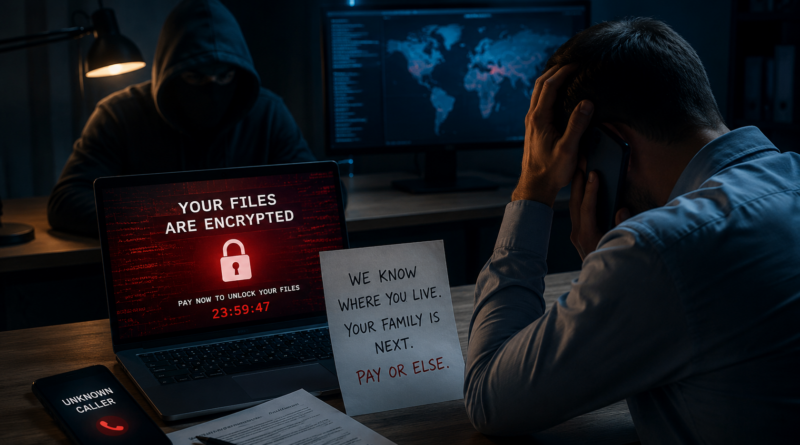
Cyber Criminals Are Now Using Real-World Threats To Pressure Victims
Cyber-attacks are no longer limited to stolen data and locked computer systems. Security experts say a growing number of hackers are now using physical threats, intimidation, and even violence to force victims into paying ransom demands. The rise in ransomware attacks and online extortion cases has made cybersecurity one of the fastest-growing concerns for businesses worldwide.
The shift marks a dangerous new phase in cybercrime, where online attacks increasingly spill into the real world.
Tim Beasley, who works for US cybersecurity company Semperis, experienced this firsthand. A few years ago, while handling ransom negotiations for a government organization hit by hackers, he found a mysterious package outside his home.
Inside was a threatening message warning him to back off or face physical harm.
“I opened the box and immediately threw it away,” Beasley recalled.
What once seemed rare is now becoming more common. Cybersecurity experts say criminals are no longer satisfied with digital pressure alone. They are now targeting employees personally, using stolen information like home addresses, phone numbers, and family details to create fear. As data breaches and hacker attacks continue increasing globally, companies are facing new risks that go far beyond computer systems.
According to new FBI data, cybercrime complaints in the United States crossed one million last year, reaching record levels. Financial losses linked to online fraud, ransomware, and business cyber-attacks also surged past $20bn.
Most ransomware attacks follow a familiar pattern. Hackers break into company systems, steal sensitive information, or lock organizations out of critical infrastructure. The criminals then demand money in exchange for restoring access or preventing the release of confidential files. But modern cybercrime is becoming far more personal and aggressive.
One of the most alarming developments is the rise of direct intimidation against employees.
Security advisor Zac Warren from cybersecurity firm Tanium described one hospital cyber-attack where staff members started receiving threatening phone calls during the ransom negotiations. The attackers reportedly called nurses by name and revealed private details, including home addresses and social security numbers.
The goal was simple: make employees feel unsafe and constantly watched.
Hackers are increasingly using leaked personal data to pressure victims psychologically. With personal information now widely available through data leaks and online breaches, cybercriminals can create fear far more easily than before.
In some cases, the risks go even further. Security experts say attackers have shown they can remotely control industrial machines, factory systems, and automated equipment. By turning machines on and off, criminals demonstrate they have access to systems that could potentially cause injuries or even fatalities if misused.
Many ransomware gangs operate internationally, with some reportedly linked to countries such as Russia, China, Iran, and North Korea. However, experts say most physical threats come from financially motivated criminal groups rather than state-sponsored hackers.
According to FBI investigations, many members of modern cybercrime gangs are surprisingly young, often between 17 and 25 years old. Despite their age, these groups have built sophisticated online criminal networks focused on ransomware, online fraud, and digital extortion.
Experts say hackers themselves often avoid carrying out physical violence directly. Instead, they recruit others through online forums, encrypted messaging apps, and social media communities.
“They don’t want to get their own hands dirty,” Beasley explained.
Criminals may pay others to stalk victims, damage property, deliver threats, or intimidate employees in person. Law enforcement agencies say this growing “violence-for-hire” model is becoming increasingly common within organized cybercrime.
Some of the most serious real-world attacks connected to cybercrime are now happening in the cryptocurrency industry.
Last year, French police rescued the father of a cryptocurrency millionaire who had reportedly been kidnapped and held for ransom near Paris. According to reports, the victim even had one of his fingers cut off during the attack.
The incident highlighted the growing dangers surrounding cryptocurrency wealth and online visibility. Cybersecurity experts warn that many crypto investors unintentionally attract criminals by publicly discussing profits, investments, and expensive lifestyles on social media.
Adam Meyers from cybersecurity company CrowdStrike says that visibility can quickly turn into risk.
“People in crypto often talk publicly about how much money they’ve made,” he explained. “That attention can become dangerous.”
Unlike traditional bank accounts or physical assets, cryptocurrency can sometimes be transferred almost instantly, making wealthy investors attractive targets for criminals seeking fast payouts.
Law enforcement agencies are also warning about the rise of what experts call “violence-as-a-service.” This refers to criminal networks offering physical attacks in exchange for payment through underground online communities.
According to Europol and the FBI, some groups now advertise services ranging from intimidation and stalking to arson, assault, and kidnapping. Online criminal communities have become increasingly organized, connecting hackers with people willing to carry out real-world violence.
The FBI recently warned about networks tied to online communities sometimes referred to as “The Com,” where criminals allegedly coordinate hacking operations, extortion schemes, and violent attacks.
Security experts say less technically skilled criminals often turn to violence because they lack advanced hacking abilities. That combination of cybercrime and physical intimidation is creating a new kind of threat many businesses were never prepared to handle.
Experts believe the rise in physical threats is largely driven by money. Criminals understand that fear works. When victims worry about their families, homes, or personal safety, they are far more likely to pay ransom demands quickly.
Beasley says many organizations pay simply because they fear what could happen if they refuse.
“They don’t want their kids getting kidnapped,” he said.
That fear is exactly what modern cybercriminals are exploiting.
Cybercrime is no longer just about hacked passwords and stolen data. Today’s attackers are increasingly using intimidation, stalking, and real-world violence to pressure victims into compliance.
As ransomware gangs grow more aggressive and personal data becomes easier to access online, cybersecurity is becoming just as much about physical safety as digital protection.
For businesses, employees, hospitals, and cryptocurrency investors, the message is becoming impossible to ignore: online threats are no longer staying online.