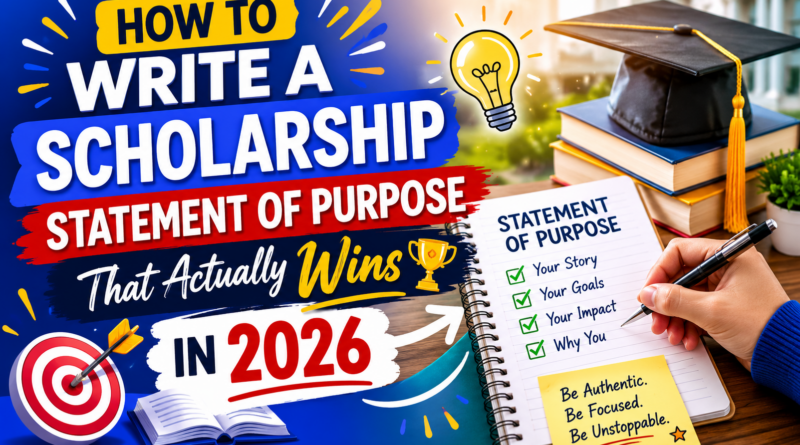
How to Write a Scholarship Statement of Purpose That Actually Wins in 2026
A strong scholarship statement of purpose is what separates winners from the thousands of qualified applicants who get rejected. Your grades and references prove you are capable; your essay proves you are worth investing in. Here is exactly how to write one that stands out in 2026, without the clichés that selection panels are tired of reading.
Understand what the panel is really looking for
Reviewers are not just measuring your achievements. They want to know who you are, why this specific programme fits your goals, and what you will do with the opportunity afterwards. A winning statement answers three quiet questions running through every reader’s mind: Why you? Why this programme? And why now? Keep those in view and your essay gains instant focus.
Open with a hook, not a cliché
Skip “Ever since I was a child…” and “I have always been passionate about…” Panels see these lines hundreds of times. Instead, open with a specific moment, problem or observation that pulled you toward your field. A concrete scene — a patient you met, a flawed system you noticed, a project that changed your thinking — earns attention far faster than a grand abstract claim ever will.
Build a clear, logical structure
The strongest statements follow a simple arc. Begin with that hook, then explain your academic and professional journey and what shaped your goals. Move into why this particular programme, university and country are the right fit, naming specific courses, professors or research that genuinely interest you. Then describe the impact you intend to make, ideally tied to your home community or field. Close with a confident, forward-looking ending that ties back to your opening. Each paragraph should earn its place; if a sentence does not move your story forward, cut it.
Be specific, and show rather than tell
Vague ambition reads as filler. “I want to help people” means little; explaining how a particular skill will solve a particular problem means everything. Use real examples and modest, concrete details instead of grand adjectives. Specificity is also your best defence against sounding generic or, worse, sounding like everyone else who used the same template.
Avoid the mistakes that sink applications
The most common failures are easy to fix: trying to cover your entire life, repeating your CV in paragraph form, flattering the university with empty praise, and ignoring the actual prompt. Watch your length too — most panels want focus, not padding. Proofread ruthlessly, read it aloud to catch clunky phrasing, and tailor every version rather than mass-sending one essay to every scholarship.
A simple paragraph-by-paragraph template
If you are staring at a blank page, this skeleton helps. Paragraph one: your hook — a specific moment that drew you to the field. Paragraph two: your academic and professional journey and what it taught you. Paragraph three: why this exact programme, university and country fit your goals, with concrete details. Paragraph four: the impact you intend to make afterwards. Paragraph five: a short, confident close that loops back to your opening. Fill that frame with honest specifics and you already have a coherent draft.
Tailor every version
The fastest way to lose is to send one identical essay everywhere. Selection panels can spot a recycled statement instantly, especially when you forget to change the university’s name. Keep a strong master draft, then rewrite the “why this programme” section for each application using details only that programme offers. This takes time, but it is the single change that most reliably moves an essay from forgettable to competitive.
Length, tone and a final checklist
Respect the word limit — going over signals you cannot edit, while padding to fill space dilutes your message. Keep the tone confident but humble, and write the way a thoughtful person speaks, not in stiff, formal jargon. Before you submit, run a final check: Does it answer the prompt? Is every claim specific? Have you removed clichés and repetition? Did you proofread aloud and have someone else read it? If yes, you are ready.
Strong openings versus weak ones
The difference is concrete detail. A weak opening says, “I have always been passionate about medicine and helping people.” A strong one drops the reader into a moment: the night a relative’s misdiagnosis sent you searching for answers, or the clinic where you first saw a system fail. Specifics create images, and images stick. Whenever a sentence could have been written by any applicant, rewrite it until it could only have been written by you.
Get a second pair of eyes
You are too close to your own story to judge it clearly. Before submitting, ask a mentor, teacher or friend to read it and tell you what they remember afterwards — if the answer matches your intended message, it works. Fresh eyes catch confusing logic, unsupported claims and typos you have read past a dozen times. A short feedback loop in the final days often lifts a good essay into a winning one.
One last thing
Your statement of purpose is the one part of the application where your personality, not just your grades, gets to speak. Give it the time it deserves, write it like a real person, and let it sound like you. Done well, it is what makes a panel remember your name long after they close the file.
Used well, modern tools can sharpen structure, flag weak sentences and check grammar in minutes — but the voice and the story must remain yours. Panels can smell a generic, machine-written essay, and authenticity is what wins. To edit and polish responsibly without losing your own voice, see our roundup of the best free AI tools of 2026, then give yourself a few days to revise before the deadline.